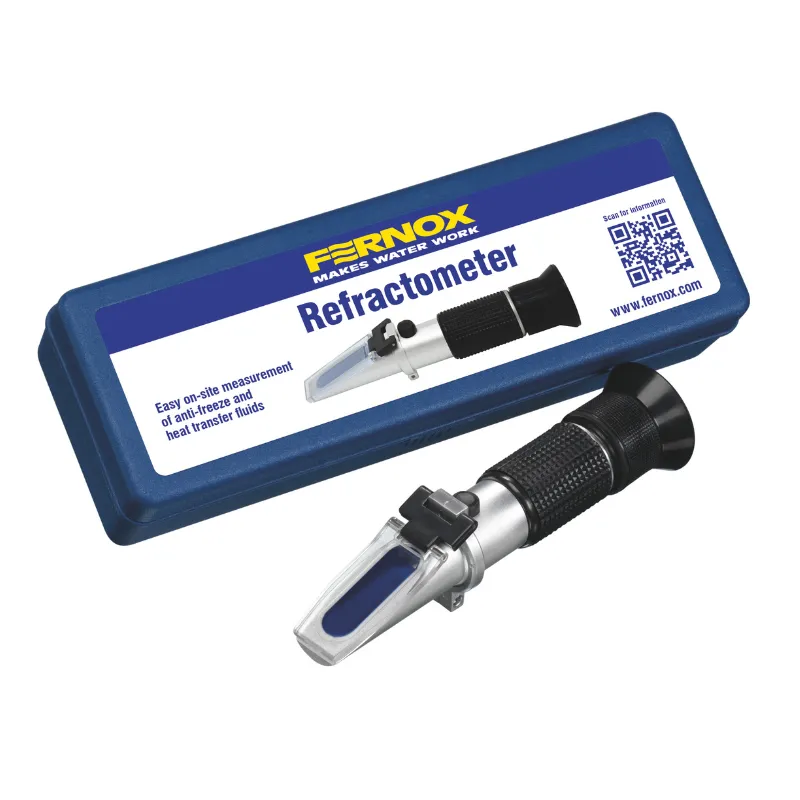
Refractometer

Code:
62733

Accurate, easy-to-use antifreeze testing instrument uses an adjustable eye piece to measure refracted light given off by all glycol-based antifreeze products, to determine the concentration of treatment present in the system.

  • Easy on-site measurement of antifreeze and heat transfer fluids
  • Adjustable eye piece
  • Easy to use
  • Quality, maintenance-free instrument

Application

The refractive Index of a material is an optical measurement of its ability to bend a beam of light entering it. The refractive index may be used to determine the concentration of a material when dissolved in water, due to the difference in refractive index between water and the material being monitored. All glycol-based antifreezes will refract light and this property can be used to determine the concentration of treatment present.

How to use:

The Refractometer has an adjustable eyepiece. If the user normally wears spectacles, it may be that the scale is sharper without them. For Calibration please refer to the procedure in the instructions leaflet. When determining the concentration of antifreeze in a water system, it is advisable to take the average of two or three readings, if time permits.

Test Procedure:

Take a small sample of test solution into a clean container. Ensure that the sample does not contain grit that could scratch the prism. Allow the samples to cool to room temperature before testing. Very hot solutions could crack the glass prism and will also give inaccurate results. Open the cover plate situated at the end of the instrument furthest away from the eyepiece and place a drop 2-3 drops of test sample on the prism. Use only plastic applicator rods as the prism glass is relatively soft and can be easily scratched. Close the cover plate and direct the instrument towards a convenient light source. Looking through the eyepiece, a circular field will be seen with a vertical scale down the centre. When an optically active material is present in the sample, the field will also be split horizontally into dark and light areas. The position at which the demarcation between light and dark crosses the vertical scale is the point from which the reading should be taken. Select an appropriate scale for the type of antifreeze being tested.
Read off the concentration of antifreeze and compare with the guideline concentrations.

Volumetrics
CodeSingle Unit BarcodeSingle Unit Dimensions(Height x Width x Depth)Outer Carton Barcode (ITF)Outer Carton Dimensions(Height x Width x Depth)
62733
5014551627338
x x "
05014551003859 Box of 25
x x "
Downloads

Featured Products

Country

Product Instructions

Simple test for antifreeze concentration

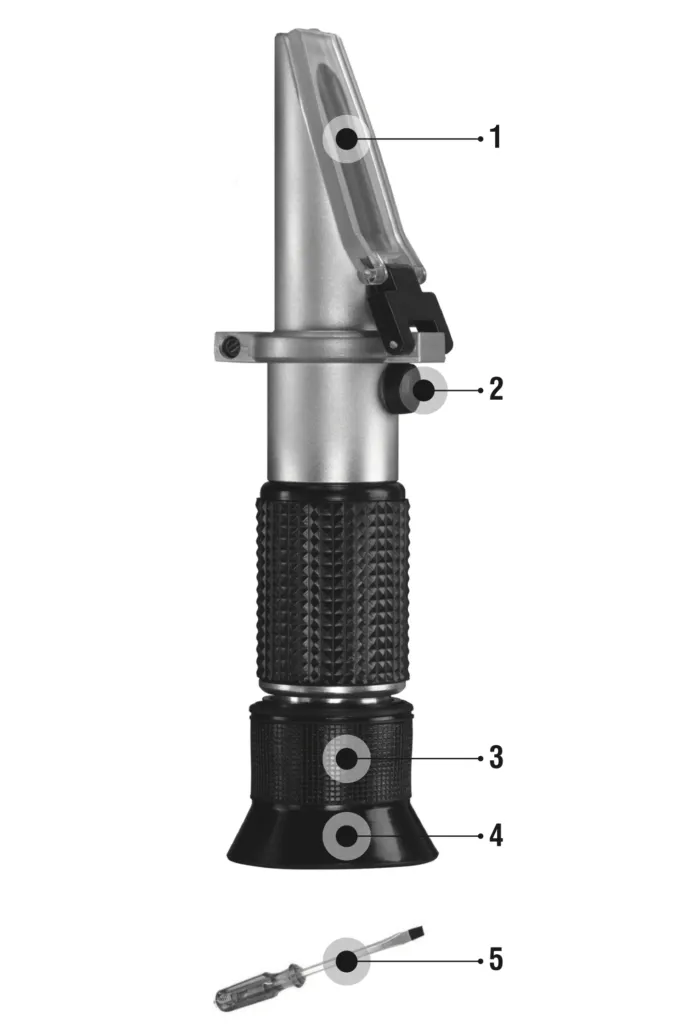
1. Daylight Plate

2. Calibration Screw

3. Focus Adjustment

4. Eyepiece

5. Calibration Screwdriver

RangeMin Div./Accuracy
Ethylene Glycol-50°C–0°C (0–70%)±5°C (5%)
Propylene Glycol-50°C–0°C (0–70%)±5°C (5%)

How to use

1. To calibrate, aim the front of the Fernox Refractometer in the direction of bright light and adjust the eyepiece until the reticle can be seen clearly.

2. Open the daylight plate and pipette 2–3 drops of water onto the main prism. Close the daylight plate and press it lightly so the water spreads across the entire surface of the prism without air bubbles or dry spots. Allow the sample to remain on the prism for approximately 30 seconds.

3. Adjust the calibration screw until the light/dark boundary coincides with the zero line. Adjustment of the refractometer with temperature compensation should ideally be made at an ambient temperature of 20°C. If the ambient temperature changes by more than ±2°C, recalibrate using the above steps to maintain accuracy.

4. Only use the refractometer after calibration. To take a reading, open the daylight plate and clean the prism surface with a soft cotton cloth. Pipette 2–3 drops of the solution to be measured onto the main prism. Close the daylight plate and press lightly. Looking through the eyepiece, read the scale at the light/dark boundary. The reading will show the percentage of fluid and the corresponding frost protection (°C).

5. After measurement, clean the prism and cover plate using a moist cotton cloth.

Maintenance

When used appropriately, the Fernox Refractometer is maintenance-free.

Points to note

When adjusting the zero point, the water and solution should be at the same temperature. If the temperature varies, the zero point should be adjusted every 30 minutes.

Do not wash the refractometer, as water may enter the instrument.

Handle with care and avoid scratching the optical surfaces.

The Fernox Refractometer should be stored clean and dry in the box provided.

Product Instructions